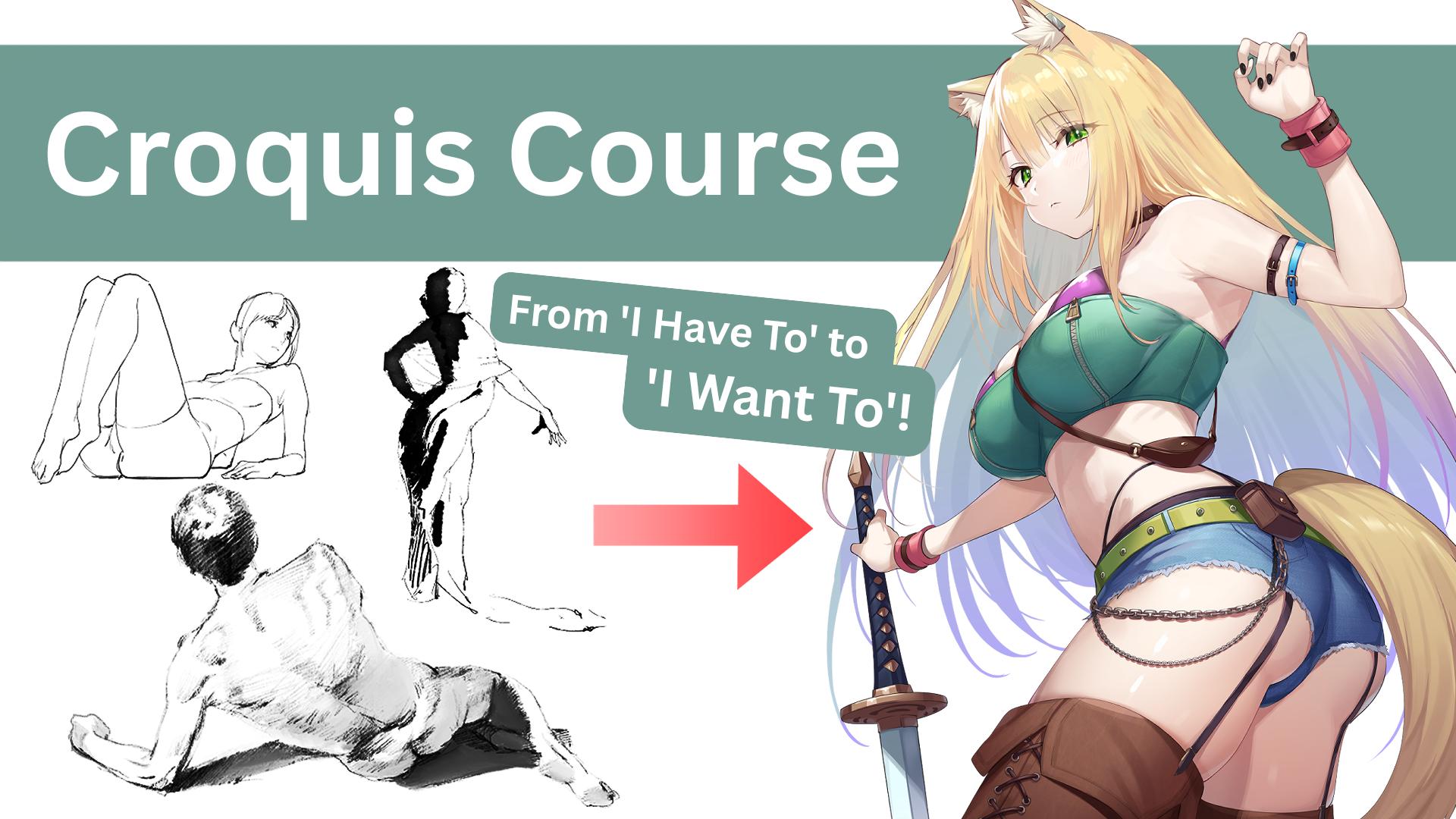
Croquis Techniques That Directly Boost Your Illustration Skills
Goshichi Shoji
Archives
Seminar
Improvement Of Skill
In this seminar, you'll learn concrete techniques to turn croquis—which too often ends at 'just drawing'—into a practice that directly improves your illustration skills. Based on a professional's thought process, you'll analyze your own croquis, pinpoint your weaknesses, and build an action plan for improvement. Move beyond aimless practice and lay a foundation for steadily growing your drawing ability.
DateTime:
2026/04/17 20:00 JST
Duration:
1:30:00
Venue:
Discord
Caption:
,
Order deadline:
Unlimited
Viewing deadline:
Archive available
Notice:
Please note: this course is a recording of a seminar conducted in Japanese. English subtitles have been added.
Currency:
USD, JPY
Has Your Croquis Become All About “Just Drawing”?
No matter how many you draw, your art isn’t changing… The reason may be that your croquis and your illustration work have become “disconnected.”
“I do croquis every day, but the moment I sit down to draw an illustration, the pose won’t come together and the body looks unnatural.” Many people share this frustration. The cause is that the “mental circuit” for applying what you gain from croquis to your illustration work simply isn’t connected.
Many artists are satisfied just with drawing the lines of a croquis, and never spend enough time afterward analyzing “what they gained” or “how it applies to their own art.” Before any surface-level technique, professionals use croquis as a “diagnostic tool for discovering and solving their own weaknesses.” In this course, you’ll install that professional thought process and learn how to turn croquis into genuine fuel for improvement.

Have You Become “Lost” in Your Croquis Practice?
✔︎ You do croquis but leave it at that, and never really feel it leading to improvement
✔︎ You blindly count your streak of days or number of sheets, and practice itself has become the goal
✔︎ The benefits of croquis feel unclear, and you practice with a nagging sense of emptiness
More Than Just Drawing: The “PDCA Croquis” Approach to Leveling Up Your Illustration
A logical way of thinking that translates croquis into illustration
Shift your perspective from “drawing a pose” to “extracting the elements you can use in your illustrations.” You’ll understand the structural link between croquis and illustration, and learn how to reflect your practice directly in your finished art.

Using croquis as a “diagnostic tool” to objectively assess your weaknesses
Rather than judging the polish of a croquis, you’ll learn how to objectively assess which elements—sense of volume, structure, silhouette, and more—are lacking. You’ll analyze the parameters of your own art and pinpoint the weakness you should tackle first.

Building a concrete action plan (PDCA) to solve your weaknesses
You’ll learn how to design your own practice methods and action plan—time allocation, number of poses, intervals, and so on—to close the gaps you’ve identified. In the course you’ll learn how to build a Before/After action plan, so you can practice with clear direction and no hesitation.

Graduate From Aimless Practice and Get Your Roadmap to “Improvement With a Reason.”

Truly understand how croquis connects to illustration
By understanding the meaning of croquis at its root, the quantity and quality of what you take from each single sheet improves dramatically. When you create illustrations, you’ll naturally draw on the knowledge and instincts you’ve built through croquis.

Clarify your weaknesses and practice without hesitation
You’ll develop an eye for viewing your own art objectively, making it clear what you should practice right now. You’ll stop wasting time on aimless practice and start feeling efficient progress even with limited time.

Learn to build your own optimal croquis action plan
Using the PDCA framework you learn in the course, you’ll be able to keep updating your practice methods on your own—matched to your level and your weaknesses—long after the course ends. You’ll gain the self-driven ability it takes to go pro.
Six Learning Steps to Turn Croquis Into Fuel for Improvement

The core principle of improvement: storing and outputting a “mental image of the finished work”
Understanding the structure of how art improves—converting from flat to three-dimensional, then applying it to the human body. • The importance of a “library of visual images,” essential for drawing without reference. • How a foundation in three-dimensional form, plus a stock of finished-image references, drives your skill upward.

Breaking free from mindless copying: connecting croquis to illustration work
The structural reason why simply churning out sheet after sheet won’t improve your illustration. • Concrete strategies for using croquis to build a rich stock of finished images. • A way of thinking that translates the know-how gained from croquis into actual character creation.

Know where you stand: using croquis as a diagnostic tool
Evaluation criteria for objectively measuring your weaknesses—not the “polish” of a croquis. • Self-analysis through four lenses: sense of volume, structure, silhouette, and detail. • A method for visualizing the parameters you lack and setting the direction of your future practice.

Identify your growth bottleneck: overcoming weaknesses in “structure” and “silhouette”
Pinpointing the single weakness you should solve first through multi-parameter analysis. • An explanation of the common tendencies behind the “structure” and “silhouette” weaknesses that trip up so many artists. • Setting concrete focal points so you approach croquis with a clear awareness of your weaknesses.

Avoid the pitfalls and lock it into memory: “drawing from memory” and “proportion adjustment”
Analyzing human anatomy (joints and muscles) to prevent the “surface-level understanding” that comes from drawing quickly. • The how-to and benefits of “memory copying”—drawing from memory to vividly retain visual images and expand your library. • Practicing “proportion adjustment”: converting the body proportions from a croquis into the head-to-body ratios of character illustration.

Trace a professional’s thinking: building PDCA through demonstration and practice
Sharing in a professional’s observational eye and process of choosing what information matters, through Goshichi’s live croquis demonstration. • Hands-on work where you do croquis on the spot using the perspectives you’ve learned and extract your own weaknesses. • Taking home how to build “your own action plan” you can use starting tomorrow, through a group review with all participants.
About the Instructor
Goshichi Shoji — Illustrator
Graduated from the School of Art and Design at the University of Tsukuba. Five years of experience as an illustrator. He creates character illustrations across a wide range of fields, including VTubers, light novels, and social games. He has appeared as an instructor for the drawing course Palmie and for POSEMANIACS, and has contributed to the writing of illustration technique books.

A Message From the Instructor
I know just how hard it is to “give it your all.” That’s exactly why I want every bit of your effort to pay off—and that wish is where this seminar comes from. Croquis is steady, disciplined work, so for some people it can be quite a struggle. If you’re going to put in that effort, I want it to deliver 100%, even 120% of its potential! And I believe I know how to make that happen. To everyone struggling with croquis: please use this seminar to make your croquis truly worthwhile!
Curriculum & Session Flow
*Please note: parts of the structure and timing may be adjusted depending on how the session progresses. Introduction • Overview • Redefining the problem: why croquis doesn’t lead to improvement • The goal of this course: from Before (aimless croquis) to After (croquis that connects to illustration) • The big picture Chapter 1: How do you improve your illustration through croquis? • Understanding the process and structure of how art improves • Converting to three dimensions, and the importance of holding a mental image of the finished work • What you can learn from croquis, and what it means for illustration work Chapter 2: Solving your weaknesses through croquis • Using croquis as a diagnostic tool • How to find your weaknesses (lenses: sense of volume, structure, silhouette, detail) • Identifying the weakness to prioritize first Chapter 3: Concrete examples of linking croquis to real improvement • Methods for analyzing human anatomy (joints, muscles, proportions) • The how-to and benefits of memory copying and proportion adjustment (introduction) • Avoiding the hidden pitfalls of croquis Chapter 4: Instructor demonstration and action-plan building • A live croquis-and-analysis demonstration by Goshichi • Hands-on practice where participants analyze their own croquis and extract their weaknesses • How to build your own action plan (PDCA plan) • Group review and Q&A
Make the Decision: Leave Blind Effort Behind and Walk the Path of Steady Improvement With a Professional’s Mindset.
“Thirty minutes of croquis every day.” That effort is truly wonderful—but if each sheet ends at “just drawing,” you may be spilling the very chance to improve over the far side of the canvas. Time is finite. Especially for those learning art while working or raising children, every minute and second of practice should be more precious than anything. So why not invest those minutes and seconds—not in surface-level tricks, but in a lifelong “mindset for improvement”? What you’ll learn in this course are the “croquis techniques that directly boost your illustration skills,” built and refined by the instructor himself over years of trial and error. Rather than relying on instinct, you’ll analyze your own art logically, identify your weaknesses, and change your actions. Becoming able to run that PDCA cycle yourself is the surest shortcut to going pro. Will you keep drawing blindly, trusting that someday you’ll get better? Or will you, in just 90 minutes of learning, finish one “meaningful sheet” and gain days where you can feel your progress with confidence? I look forward to sharing the moment your “croquis perspective” changes dramatically. Let’s make today the day croquis stops being “just drawing.”
講座詳細
| 開始日時 | 2026/04/17 11:00 |
| アーカイブ | あり |
| 開催場所 | Discord |
アーカイブ動画の視聴について
アーカイブはポーズマニアックス上で視聴可能です。セミナー開催から公開まではお時間をいただく場合があります。
TEACHER

Biography
Active since 2020. He mainly creates character illustrations, and also writes technique books, provides artwork critiques, and appears as an instructor. • Seibundo Shinkosha — "Complete Guide: Techniques for Drawing Expressive, Sparkling Eyes (Kaki-Tech!)" • MF Bunko J — illustrator for "What If I Could Telepathically Connect With the Guy I Absolutely Hate!? (by Keisho Katsubi)" • Palmie Inc. — MV production and judge for the "9th Anniversary Illustration Contest"